Roof of Hafez's Tomb

Roof of Hafez's Tomb
Showing posts with label Ancient history. Show all posts

Tuesday, November 5, 2013

Babur's Gardens: An Oasis in Kabul


Like most Tuesday afternoons, I attended "Pashto coffeehour" today where students of the Pashto language can practice their speaking skills with local Afghans and Ostad Rakhmon Inomkhojaev--Senior Specialist of Afghan languages at IU. Since learning of Professor's Inomkhojaev's  upcoming retirement, I've developed a deeper appreciation for these coffeehours and the opportunity to study Pashto--a language I first fell in love with back in 2007. Having a background in Pashto made learning Persian a little less of a hurdle and I'm currently trying to develop my ear for Dari. I've found watching "Voice of America" broadcasts to be the best strategy where I jot down new word I hear, pause the video, and look it up with a dictionary or on google translate. I also get to mess up a lot and confuse the two languages in front of Rakhmon as I try to compartmentalize everything. It's a labor of love though! Along with being incredibly patient, one of Rakhmon's many strengths is Mughal poetics and he loves to discuss the historical sites of Afghanistan. Today he talked about Babur's Gardens in Kabul during coffeehour.

After decades of war and neglect, Babur's gardens have been completely restored thanks to the Aga Khan Foundation who began rebuilding the site in 2002. It receives thousands of visitors every week and has become an oasis for the residents of Kabul to relax, have picnics, and spend time with friends and family. Babur, the founder of the great Mughal Dynasty, is buried there and the site has expanded into an enormous complex of gardens and waterways. His tomb is rendered in white marble with a plaque bearing his last wish:  "If there is a paradise on earth, it is this, it is this, it is this." In a lot of ways, Babur's garden has become a type of paradise--at least a weekend escape for city dwellers. Someday I'd like to visit, but in the meantime there are some great videos that document the transformation of the site in English and Dari:


Extra Links:


Wednesday, February 13, 2013

Textbooks for Ancient Iranian Languages

One of the most challenging aspects of studying any ancient language is the shortage of teaching materials, textbooks, and dictionaries for students to use. Older forms of Persian (like Pahlavi) certainly has this issue and if you're not familiar with reading linguistic descriptions of grammar, you may be desperate for more simple explanations as to how this language works. As much I loved studying Pahlavi, I struggled with it-- spending up to 5 or 7 hours on 15 lines of text only to come to class with a third or more of it totally wrong. What tripped me up was deciphering the letters. It wasn't until the end of last semester did I discover the textbooks of Prods Oktor Skjærvø-- a Norwegian-born linguist and scholar of Iranian languages at Harvard University (NELC dept). He has written learning materials for Avestan (young and old), Old Persian cuneiform, Middle Persian, and Manichaean Sogdian. All of these publications are free and available for download on his website. The Pahlavi Primer can be downloaded here. Thanks to Dr. Skjærvø for sharing his work with the online community! Here is a short interview with him by Pars Times:

Saturday, February 9, 2013

Sassanian Seals

This semester my Middle Persian-Pahlavi language class has decided to finish deciphering a collection of Sassanian seals that was sent to my department for consultation. I'm in charge of providing our group with play-doh in order to 'stamp' the seals which can show us details that are difficult to see on the quartz surface. Many of the seals have Pahlavi inscriptions and our goal is to try to translate them into English. Translating may sound straightforward-- but if anyone has ever looked at the 'modified Imperial Aramaic' alphabet that Pahlavi uses, it's rarely straightforward because the shapes of the letters all look alike and tend to change over time. With play-doh, magnifying glasses, individual reading lights, and an enormous stack of reference books-- we could not look more nerdy. I love it, and below are some examples (from the internet) of what these artifacts look like.

Zoroastrianism: Change and Continuity

Last week the School of Oriental and African Studies in London held the Inaugural Lecture of Zartoshty Professor Almut Hintze, an eminent scholar of the Zoroastrian religion and Indo-Iranian languages. Below is her video-- I suggest starting at 12:30. It's a about an hour long and a good survey of the religion. My favorite part is her discussion of how and why the word 'daeva' became a negative term to describe a class of demons in Zoroastrianism that chose to follow Angra Mainya. The synopsis (at the end of the lecture) was also a nice addition.

Thursday, January 10, 2013

New Year...New Semester

After taking a month off to finish final exams and celebrate the holidays--I'm back at IU and back to blogging! One of my favorite classes this semester is a directed readings course with Dr. Choksy who is an expert of Ancient Iranian Studies and Zoroastrianism. The topic for the course is Pre-Islamic archaeology and the theme of sacral kingship. Here is an article that he wrote for the The Circle of Ancient Iranian Studies about this exact topic: Sacral Kingship in Sasanian Iran. This week I'm reading a detailed archaeological survey of Iran written as a travel guide by Sylvia Matheson in the early 1970s. She travels to each province of the country highlighting the most impressive sites (of the supposed 250,000) and adds several notes about hotels, chaikhanas (tea houses), and transportation. I feel like I'm touring the country with her...but at the same time, I'm reminded how difficult it would be to recreate her path of travel nowadays. Paths of travel, especially disrupted ones, is a theme of another course I'm taking on Nomadic Pastoralism of Eurasia with Dr. Shahrani. Many of the migration patterns of Euraisan nomads as well as Iranian nomads were disrupted with forced settlement for taxation, and pressures to urbanize and modernize. Ideology, perhaps more than anything else, has brought nomadism to an end. Yet connections are forged as scholarship, literature, and art--whether ancient or contemporary, can speak to us across these limitations of space and time. The intense documentation of Matheson's work was perhaps intentional--foreshadowing the rise of the Islamic revolution and the future of Iran's relationship to the West. As I work towards the end of my first year as a PhD student, I appreciate documentation more and more, and nothing seems as esoteric. Happy new year to my blog readers and wishing you many moments worth capturing!

S. Matheson in Iran

Saturday, December 8, 2012

Paradise Lost

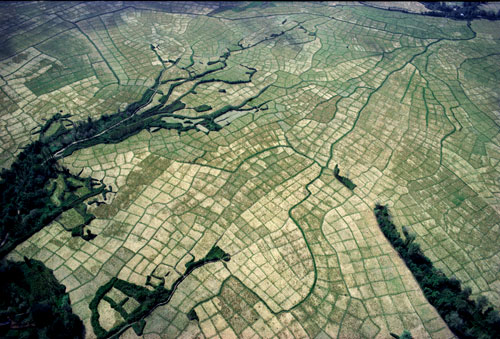
As a final presentation for my Persian language course, I recently made a PowerPoint about Iran's diverse geography and landscape. I used several images from one of my favorite photography books-- Paradise Lost: Persia from Above by Georg Gerster. Between 1976 and 1978 (right before the Islamic revolution) Gerster was granted rare permission from Queen Farah Pahlavi to record the landscapes and cities of Persia through aerial photography. My favorite photos are those of old citadels and oases irrigated through qanats (see the last image). The title suggests that 'paradise' is lost because since 1979 no one has been able to document Iran's geography this thoroughly-- in fact, the only aerial imagery we see today from Iran are poor-quality photos of nuclear facilities. Several of Gerster's images also document many places that have been destroyed by earthquakes since the 70s-- making Gerster's project even more valuable. Highly recommended for anyone interested in Iranian history, agriculture, and art.

The word 'paradise' is derived from the the ancient Iranian word--'paridayda' in Old Persian (rendered 'parádeisos' in Ancient Greek) which was meant to describe an oasis or cultivated area. The ability to channel water into the deserts was indeed one of the most transformative engineering feats of ancient Iranians and was deemed sacred. The ancient gardens of Cyrus the Great were therefore called 'paridayda'. 

Monday, August 20, 2012

Pahlavi Begins!

Classes started today at IUB and Pahlavi (Middle Persian) with Dr. Choksy already looks terrific. Pahlavi is an older form of modern Persian (or Farsi) and was officially used from 224-651 AD. It's largely associated with the Sasanian Dynasty and Zoroastrian texts. The Pahlavi writing system uses a modified Aramaic script with a few variants such as "Book Pahlavi" vs. "Inscriptional Pahlavi" which was used on coins and seals. It's written from right to left:


There's not really a 'textbook' for Middle Persian--just a handful of dictionaries from what I can tell.  Here's what we have lined up for the semester:
1) The Kārnāmag-ī Ardaxšīr-ī Pābagān or Book of the Deeds of Ardashir: The book narrates the epic adventures of King Ardashir, the founder of the forth Iranian dynasty, and the second Persian Empire. The story relates how Ardashir's father Papag, dreamed that his father Sasan would be reborn as Ardashir.
(In other words, a mythical genealogy story).
Ardashir's Coin
2)The Shahpur I Inscription: Shahpur I was the son of Ardashir and this is text describes the religious and political condition of the Sansanian Dynasty-- reminiscent of Behistun inscription of Darius I.
Shahpur's Coin
3) A selection of Zoroastrian texts--perhaps something like this: a page from the Pahlavi Denkard (a ninth century encyclopedia of the Zoroastrian religion)


4) The Bundahishn-- the Zoroastrian "creation story" and a source of Zoroastrian cosmogony/cosmology. 
Here's the intro page:

Wednesday, June 27, 2012

More on Zoroastrianism


The significance of the Faravahar, the symbol of Zoroastrianism

1. The figure inside is that of an old man, representing wisdom of age.  
2. There are two wings which have three tiers of feathers. These three tiers symbolize "good thoughts, good words, and good deeds".
3. The lower part of the Faravahar consists of three more tiers of feathers which represent "bad reflections, bad words and bad deeds" --the causes of  misery and misfortune for human beings.  
4. There are two ribbons on each side of Faravahar which symbolize positive forces and negative forces.  The former is directed toward the face and the latter is located at the back. This also indicates that we have to proceed toward the good and turn away from bad. 
5. The ring in the center symbolizes the eternity of the universe or the eternal nature of the soul. As a circle, it has no beginning and no end.  
6. One of the hands points upwards, indicating that there is only one direction to choose in life and that is forward. The other hand holds a ring. Some interpreters consider that as the ring of covenant, representing loyalty and faithfulness--the basis of Zarathustra's philosophy.

Since, the ring of covenant which located in the center of the Faravahar's trunk is the symbol of the immortality of the spirit, it can be inferred that the more human beings try to promote their own Faravahar, the more their spirit will be elevated in heaven after they pass away.

(article from Iransara.info)

Monday, June 25, 2012

Tribute to Zoroaster / Zarathustra / زرتشت


This week I'm giving a presentation in Persian about Zoroastrianism -- one of the oldest religions in the world. Zoroaster was its founder and I've collected a number of portraits of him from the internet. Zoroaster's message was simple: 
Good Thoughts, Good Words, Good Deeds.

Friday, June 15, 2012

Videos on Ancient Persia

In preparation for taking 'Middle Persian/ Pahlavi language' next semester with Professor Choksy, I've been trying to brush up on the history of Pre-Islamic Persia.  So far, I've watched two documentaries that review the empires of the Achaemenids, Seleucids, Parthians, and Sassanids with Cyrus the Great, Darius the Great, Xerxes, and Ardashir playing the leading roles.  While these documentaries are not very thorough, they do provide some great footage of Pasargadae, Persepolis, and Ctesiphon-- especially the incredible architectural and engineering achievements of the ancient Persians.

Here's a documentary available on YouTube in 5 parts titled Engineering an Empire -The Persians :


The second documentary, titled Iran: The Forgotten Glory, is available on NetFlix for instant viewing.

Monday, June 4, 2012

Studying Persia through Scripts

I've had an intense fascination with alphabets and scripts since I was a kid.  My parents were especially encouraging of my interest in languages and often allowed me to experiment (via paintbrush) with Hindi, Burmese, Ukrainian, and Chinese on the walls of our house and refrigerator (it helps that my mom is an artist!). As a visual learner, I can say that studying a new writing system is one of the most exciting aspects of a language course and today, our class reviewed the 33 letters of the Persian Alef-Ba. I find Persia's linguistic history --especially it's varied scripts which are thousands of years old--to be a fun way to connect with Persia's vast  history. One of my favorite websites is: AncientScripts.com. Here are a few images of Persia's many writing systems:

Proto-Elamite 
3300 BCE to 500 BCE
 Elamite
 Old Persian
550 BCE to 400 BCE
 Pahlavi (Middle Persian)
3rd century BCE to 9th century CE
 New Persian
1,000+ years old