Roof of Hafez's Tomb

Roof of Hafez's Tomb
Showing posts with label Art. Show all posts

Sunday, May 11, 2014

Picturing Shi'ism

Now that I have finally finished a very busy semester, I can start blogging again! Don't worry-- I haven't stopped immersing myself in all things Persian :) As a final project for a class about Shi'ism, I recently wrote a paper about popular devotional art from Iran and Iraq. I came into this class with a basic knowledge about Shi'ism but as I began collecting images of religious posters, banners, and internet imagery I started to understand the significant emotional dimensions of Shi'ism and how visualization stands at the very core of it. Contrary to popular belief that Muslims don't "like" figural imagery, Shi'ism has always embraced it and has popularized it to such an extent that it has become its own visual vocabulary. Every Shi'ite knows the iconic face of Imam Hussein-- his determined expression and piercing eyes in portraiture or his arrow-riddled body in combat-illustration. He was the hero-martyr in what was the most defining moment in Shi'ism-- the Battle of Karbala in the deserts of Iraq where the Prophet Muhammad's descendants were brutally murdered by the army of Yazid or taken captive. The Day of Ashura commemorates this event and people often carry posters of Hussein, Imam Ali (the cousin of the Prophet), or the 12 Imams in processions. South Asia has also had a rich tradition of Shi'ite devotional art-- depicting Hussein's horse Zoljaneh and the hand of Fatima (the daughter of the Prophet). Posters like these are very instrumental as they help create a collective memory and identity for Shi'ites as well as capture the idealized personas of the Holy family to inspire emulation among devotees. I know I was totally captivated!  

An old painting of the Battle of Karbala from Qajar Iran 

(left) Portrait of Imam Ali and his sword, (middle) Imam Hussein, Abbas, Zayneb and Ali Asghar the martyred infant, (right) Imam Hussein

Two posters of Imam Hussein in the Battle of Karbala

Imam Hussein, Imam Ali, and Abbas with the 12 Imams below including the Mahdi (the Imam in occultation) at the far left with a ray of light as his face--yet to be seen.

Two posters of Zoljaneh (Imam Hussein's white stallion), another illustration of the 12 Imams, and a photo of boys in Iraq holding a poster with Hussein and Ali

(clockwise) poster of Imam Ali in Iraq, a poster from India of a young boy and girl reading the Quran, the Battle of Karbala--its martyrs are depicted as roses, and Buraq (the Prophet Muhammad's holy steed that flies to heaven) 

A collage of Imam Ali portraits from the Internet

Islamic talisman from South Asia with the names of Ali, Fatima, Hassan, and Hussein in the stars.The hand in the middle has the names of the 12 Imams written in its palm. 

Tuesday, November 5, 2013

Babur's Gardens: An Oasis in Kabul


Like most Tuesday afternoons, I attended "Pashto coffeehour" today where students of the Pashto language can practice their speaking skills with local Afghans and Ostad Rakhmon Inomkhojaev--Senior Specialist of Afghan languages at IU. Since learning of Professor's Inomkhojaev's  upcoming retirement, I've developed a deeper appreciation for these coffeehours and the opportunity to study Pashto--a language I first fell in love with back in 2007. Having a background in Pashto made learning Persian a little less of a hurdle and I'm currently trying to develop my ear for Dari. I've found watching "Voice of America" broadcasts to be the best strategy where I jot down new word I hear, pause the video, and look it up with a dictionary or on google translate. I also get to mess up a lot and confuse the two languages in front of Rakhmon as I try to compartmentalize everything. It's a labor of love though! Along with being incredibly patient, one of Rakhmon's many strengths is Mughal poetics and he loves to discuss the historical sites of Afghanistan. Today he talked about Babur's Gardens in Kabul during coffeehour.

After decades of war and neglect, Babur's gardens have been completely restored thanks to the Aga Khan Foundation who began rebuilding the site in 2002. It receives thousands of visitors every week and has become an oasis for the residents of Kabul to relax, have picnics, and spend time with friends and family. Babur, the founder of the great Mughal Dynasty, is buried there and the site has expanded into an enormous complex of gardens and waterways. His tomb is rendered in white marble with a plaque bearing his last wish:  "If there is a paradise on earth, it is this, it is this, it is this." In a lot of ways, Babur's garden has become a type of paradise--at least a weekend escape for city dwellers. Someday I'd like to visit, but in the meantime there are some great videos that document the transformation of the site in English and Dari:


Extra Links:


Sunday, September 1, 2013

Falnama Future


Falnama is a book of omens used by fortune tellers in Iran and Turkey during the 16th and 17th centuries as the approach of the Islamic millennium (year 1000) inspired concern about the future. Individuals seeking insight into the future would engage in a series of purification rituals, turn to a random page in the Falnama, and interpret the text and drawings thereon for good or ill. Falnamas were not only common objects used by fortune tellers, but also appended to copies of the Koran commissioned by rulers and wealthy individuals. Despite its apparent popularity in the ancient world, only four copies of the large "folio" Falnamas are known to remain in existence. Thames & Hudson published a gorgeous book about Falnamas in 2010. 


I first encountered Falnamas in an art history course about images of the Prophet Muhammad and was totally captivated by their use of color and provocative imagery-- reminding me of tarot cards. As a new academic year begins, I wonder what the future looks like.  Let's hope it doesn't look like inferno!


Wednesday, March 13, 2013

Shahnameh: The Epic of the Persian Kings

A new adaption of Iran's national epic known as the Shahnameh, or Book of Kings by the poet Ferdowsi, was recently published by Quantuck Lane Press with a revised translation. Its 300 illustrations have gotten a lot of attention since some of them took over 40 hours to complete. Using photoshop, the artist Hamid Rahmanian assembled digital collages drawing from several Persian manuscript paintings to combine the best of the best and enliven these stories reflecting Iran's mythical, heroic, and historical ages. The pre-order option is available on amazon.com and should be released sometime in May. Meanwhile, the Shahnameh's website is fun to explore and gives you a good sense of the project's aesthetic. 
Here is a video of the process:


Monday, January 14, 2013

Winter in Iran

Some people are surprised to learn that it snows in Iran. It certainly does! :) Especially in Tehran and in the mountains. Here are some photos of winter in Iran:


Saturday, December 8, 2012

Paradise Lost

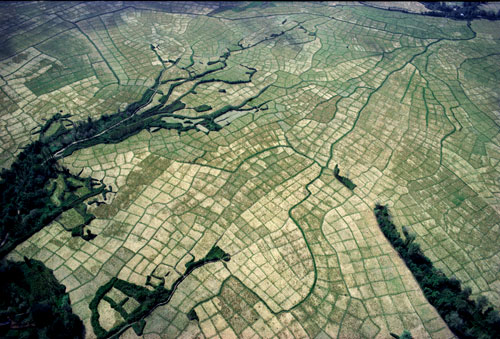
As a final presentation for my Persian language course, I recently made a PowerPoint about Iran's diverse geography and landscape. I used several images from one of my favorite photography books-- Paradise Lost: Persia from Above by Georg Gerster. Between 1976 and 1978 (right before the Islamic revolution) Gerster was granted rare permission from Queen Farah Pahlavi to record the landscapes and cities of Persia through aerial photography. My favorite photos are those of old citadels and oases irrigated through qanats (see the last image). The title suggests that 'paradise' is lost because since 1979 no one has been able to document Iran's geography this thoroughly-- in fact, the only aerial imagery we see today from Iran are poor-quality photos of nuclear facilities. Several of Gerster's images also document many places that have been destroyed by earthquakes since the 70s-- making Gerster's project even more valuable. Highly recommended for anyone interested in Iranian history, agriculture, and art.

The word 'paradise' is derived from the the ancient Iranian word--'paridayda' in Old Persian (rendered 'parádeisos' in Ancient Greek) which was meant to describe an oasis or cultivated area. The ability to channel water into the deserts was indeed one of the most transformative engineering feats of ancient Iranians and was deemed sacred. The ancient gardens of Cyrus the Great were therefore called 'paridayda'.