Roof of Hafez's Tomb

Roof of Hafez's Tomb
Showing posts with label Books. Show all posts

Saturday, January 11, 2014

New Translation of Hafez

Dick Davis was recently featured on the PBS NewsHour Weekly Poem Series to discuss his new publication: Faces of Love: Hafez and the Poets of Shiraz. Below is the link to the full article and its videos, as well as a few quotes from the accomplished translator:
"People say that Bach sort of gathered together everything that had gone before him in music and brought it into a new kind of stage. Hafez did the same with the conventions of lyric poetry." 

"One of the great things in Hafez's poetry is that it's extremely ambiguous often and that it can be read in different ways. His poetry can read in a secular way or in a religious ... that's the great problem with translating Hafez that you have this constant ambiguity and ambiguity is very difficult to transfer from one language to another."

"Different cultures put their energies into different arts at different times ... For example, you can think, painting in Italy or music in Germany, that kind of thing, but in the medieval period, the artistic energies of Iran went largely into poetry. And poetry has become part of the Persian cultural identity in a way that is true of very few other cultures."

PBS LINK:
On Amazon:

Sunday, September 1, 2013

Falnama Future


Falnama is a book of omens used by fortune tellers in Iran and Turkey during the 16th and 17th centuries as the approach of the Islamic millennium (year 1000) inspired concern about the future. Individuals seeking insight into the future would engage in a series of purification rituals, turn to a random page in the Falnama, and interpret the text and drawings thereon for good or ill. Falnamas were not only common objects used by fortune tellers, but also appended to copies of the Koran commissioned by rulers and wealthy individuals. Despite its apparent popularity in the ancient world, only four copies of the large "folio" Falnamas are known to remain in existence. Thames & Hudson published a gorgeous book about Falnamas in 2010. 


I first encountered Falnamas in an art history course about images of the Prophet Muhammad and was totally captivated by their use of color and provocative imagery-- reminding me of tarot cards. As a new academic year begins, I wonder what the future looks like.  Let's hope it doesn't look like inferno!


Thursday, January 10, 2013

New Year...New Semester

After taking a month off to finish final exams and celebrate the holidays--I'm back at IU and back to blogging! One of my favorite classes this semester is a directed readings course with Dr. Choksy who is an expert of Ancient Iranian Studies and Zoroastrianism. The topic for the course is Pre-Islamic archaeology and the theme of sacral kingship. Here is an article that he wrote for the The Circle of Ancient Iranian Studies about this exact topic: Sacral Kingship in Sasanian Iran. This week I'm reading a detailed archaeological survey of Iran written as a travel guide by Sylvia Matheson in the early 1970s. She travels to each province of the country highlighting the most impressive sites (of the supposed 250,000) and adds several notes about hotels, chaikhanas (tea houses), and transportation. I feel like I'm touring the country with her...but at the same time, I'm reminded how difficult it would be to recreate her path of travel nowadays. Paths of travel, especially disrupted ones, is a theme of another course I'm taking on Nomadic Pastoralism of Eurasia with Dr. Shahrani. Many of the migration patterns of Euraisan nomads as well as Iranian nomads were disrupted with forced settlement for taxation, and pressures to urbanize and modernize. Ideology, perhaps more than anything else, has brought nomadism to an end. Yet connections are forged as scholarship, literature, and art--whether ancient or contemporary, can speak to us across these limitations of space and time. The intense documentation of Matheson's work was perhaps intentional--foreshadowing the rise of the Islamic revolution and the future of Iran's relationship to the West. As I work towards the end of my first year as a PhD student, I appreciate documentation more and more, and nothing seems as esoteric. Happy new year to my blog readers and wishing you many moments worth capturing!

S. Matheson in Iran

Saturday, December 8, 2012

Paradise Lost

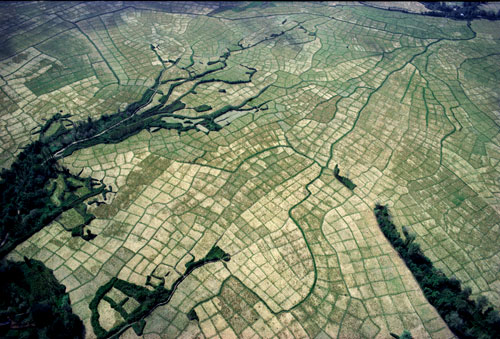
As a final presentation for my Persian language course, I recently made a PowerPoint about Iran's diverse geography and landscape. I used several images from one of my favorite photography books-- Paradise Lost: Persia from Above by Georg Gerster. Between 1976 and 1978 (right before the Islamic revolution) Gerster was granted rare permission from Queen Farah Pahlavi to record the landscapes and cities of Persia through aerial photography. My favorite photos are those of old citadels and oases irrigated through qanats (see the last image). The title suggests that 'paradise' is lost because since 1979 no one has been able to document Iran's geography this thoroughly-- in fact, the only aerial imagery we see today from Iran are poor-quality photos of nuclear facilities. Several of Gerster's images also document many places that have been destroyed by earthquakes since the 70s-- making Gerster's project even more valuable. Highly recommended for anyone interested in Iranian history, agriculture, and art.

The word 'paradise' is derived from the the ancient Iranian word--'paridayda' in Old Persian (rendered 'parádeisos' in Ancient Greek) which was meant to describe an oasis or cultivated area. The ability to channel water into the deserts was indeed one of the most transformative engineering feats of ancient Iranians and was deemed sacred. The ancient gardens of Cyrus the Great were therefore called 'paridayda'. 

Monday, October 22, 2012

Latest Reads

The fall semester is more than half way over and I can't believe how much I've read since starting classes in August. When people ask me what I've been up to, my usual answers are either 'translating' or 'reading'. Aside from a couple of Zoroastrian texts, most of my readings are Middle Eastern/Central Asian ethnographies or about Islam. Here's the full list! :

Orientalism (Said)

The Ethical Soundscape: Cassette Sermons and Islamic Counterpublics (Hirschkind)

Arab Women in the Field: Studying your own Society (ed. Altorki)

Islam in Post-Soviet Uzbekistan: The Morality of Experience (Rasanayagam)

Everyday Islam in Post-Soviet Central Asia (Louw)

Princeton Readings in Islamist Thought: Texts and Contexts from al-Banna to Bin Laden (ed. Euben)

Afghanistan: A Cultural and Political History (Barfield)

Bartered Brides: Politics, Gender and Marriage in an Afghan Tribal Society (Tapper)

Before Taliban : Genealogies of the Afghan Jihad (Edwards)

Local Politics in Afghanistan: A Century of Intervention in Social Order (ed. Schetter)

The Politics of Muslim Cultural Reform: Jadidism in Central Asia (Khalid)

The New Woman in Uzbekistan: Islam, Modernity, and Unveiling Under Communism (Kamp)

Veiled Empire: Gender and Power in Stalinist Central Asia (Northrop)

Living Islam: Women, Religion, and the Politicization of Culture in Turkey (Saktanber)

The New Crusade: Constructing the Muslim Enemy (ed. Qureshi)

Select Counsels of the Ancient Sages, also known as 'The Book of Counsel of Zartosht' (Middle Persian)

The Bundahishn ("Creation"), or Knowledge from the Zand (Middle Persian)
Portrait of a Painter: 15th century, 'Persian Painting on Facebook'
I think one of the tricks to keep your self motivated in graduate school is finding inspiration --things that get you excited and make you feel connected to the field. I always find inspiration in art and art history, so here are a couple of my favorite sites:

Facebook: Persian Painting (great collection of miniatures)...thanks to my mom for finding this one!

Facebook: Cult of the Ancient Gods (lots of ancient Persian art from Fars Province)

Tumblr: That Bohemian Girl (a beautiful style/fashion blog with Orientalist flare) 

Homa Delvaray (graphic designer from Iran)

Qajar Tile from 'Persian Painting on Facebook'

Sunday, September 2, 2012

Guest House مهمان خانه

This evening I randomly opened to page 109 of the book, The Essential Rumi by Coleman Barks, which features one of Rumi's most celebrated poems titled: The Guest House. It's a short poem, but its message is significant-- embrace all experiences, both pleasant and unpleasant, as a guide from beyond.


This being human is a guest house.
Every morning a new arrival.

A joy, a depression, a meanness,
some momentary awareness comes
as an unexpected visitor.

Welcome and entertain them all!
Even if they're a crowd of sorrows,
who violently sweep your house
empty of its furniture,
still, treat each guest honorably.
He may be clearing you out
for some new delight.

The dark thought, the shame, the malice,
meet them at the door laughing,
and invite them in.

Be grateful for whoever comes,
because each has been sent
as a guide from beyond. 

Tuesday, July 3, 2012

Tribute to Annemarie Schimmel

When I first discovered the works of Dr. Annemarie Schimmel (1922-2003), I was amazed by her prolific list of publications and lectures on Islamic India and Persian mysticism. It was obvious that after reading only a little of her writings that Schimmel had a special love for her research and tirelessly worked to highlight the rich achievements of the Islamic world in Western academia.
Schimmel's biography reads one of a prodigy:
Born on April 7, 1922, in Erfurt, Germany,  she finished high school at 15 and earned a doctorate in Arabic and Islamic studies at 19. She had a nearly photographic memory. For years she was a consultant to the Metropolitan Museum of Art in New York, where she was legendary for her ability to identify scraps of ancient text.  After earning her second doctorate, in comparative religion, Ms. Schimmel began teaching Persian and Arabic poetry at the University of Marburg in Germany. For several years she taught theology at the University of Ankara in Turkey, the first woman and the first non-Muslim to do so. In 1967 she inaugurated the Indo-Muslim studies program at Harvard, and remained on the faculty for the next quarter-century. She was proficient in Latin, Greek, Arabic, Persian, Turkish, Urdu, Sindhi, Punjabi, and Pashto. She was also a much sought-after lecturer, and her style of delivery was famous: she would clasp her purse with both hands, shut her eyes, and speak for exactly the amount of time allotted to her.
She was much loved in Pakistan and even a boulevard was named after her in Lahore:


One of Schimmel last projects was a book titled: The Empire of the Great Mughals: History, Art and Culture (2006).  It's a highly readable survey of the Mughal Empire and includes fascinating information about women at the court and the imperial household. In the coming years, I hope to travel to Lucknow, India to study Mughal Persian through the American Institute of Indian Studies. With Schimmel on my desk, I don't need to look far for inspiration :)


Sunday, June 10, 2012

New Books

It's time for some cooking and some reading! These are my latest Amazon.com orders:
Persian Cooking by Nesta Ramazani is a collection of 322 authentic recipes from one of the world's oldest culinary traditions. Persian cooking is based on vegetables, fruits, grains and meat used in subtle and varied combinations.

The Sultan's Kitchen by Ozcan Ozan contains over 130 tantalizing recipes, complete menu suggestions, and stunning images that will inspire any cook to create dishes fit for a sultan.

Rubaiyat of Omar Khayyam translated by Peter Avery.

The Poems of Hafez translated by Reza Ordoubadian

A History of Iran: Empire of the Mind by Michael Axworthy

Amir Khusro: The Nightingale of India - Selected Persian Odes translated by Khalid Shaida

Me and Rumi: The Autobiography of Shams-I Tabrizi translated by William C. Chittick, forward by Annemarie Schimmel

The Rose Garden (Gulistan) of Saadi translated by Omar Ali Shah

Ghalib, the Indian Beloved: Urdu Odes translated by Khalid Shaida

The Essential Rumi translated by Coleman Barks and John Moyne

Thursday, June 7, 2012

Seeing Iran

Traveling to Iran poses several challenges to American citizens and many friends of mine who major in Iranian Studies have traveled to Tajikistan to study Farsi. One well known photographer from LA named Mark Edward Harris, however, flew to Tehran in 2007 with the mission to photograph scenes of daily life little seen or understood by the West.  His photographs offer a fascinating look at a society of juxtapositions--ancient and modern, commercial and spiritual, serene and intense, political and personal.
Inside Iran (Chronicle Books 2008) is the first contemporary photographic book to document all regions of the country and is highly recommended for anyone interested in seeing what Iran looks like today.
Here's the link to his gallery page: http://www.markedwardharris.com/gallery_iran.html

Sunday, June 3, 2012

Classical Painting

These images come from two publications which happen to be sitting on my desk! : Persian Painting by Stuart Cary Welch and A King's Book of Kings from the Metropolitan Museum of Art. Nothing could be more inspiring!


New Books

This weekend I purchased two books for my upcoming class. The first is: An Introduction to Persian by Wheeler M. Thackston.  It's a terrific textbook because it immediately introduces the student to a difficult script called Nastaliq. Nastaliq is a calligraphy style which tends to be written on a slant and most Persian manuscripts were written in beautiful nastaliq that wrapped around illuminated miniature paintings.


The second book is a comprehensive dictionary titled: The Combined Persian-English and English-Persian Dictionary by Abbas and Manoochehr Kashani. It's a decent purchase but the typeset tends to be small and blurry. Oh well, at least the cover is a pleasant shade of green.